
Artículo: The Anatomy of a Western Shirt: The History of Every Part

The Anatomy of a Western Shirt: The History of Every Part
People ask us all the time what makes a Western shirt a Western shirt. The honest answer is that it’s not one thing. It’s a handful of details, each with its own history, that came together over about fifty years. Some started on horseback. Some started in a patent office in Germany... and Connecticut? A few started with somebody who just wanted to be seen from the back row of a rodeo arena.
So instead of a definition, here’s a tour of the shirt, from the front placket down to the tail, and where each piece actually came from.
The front: snaps came later than you’d think
Most people would say pearl snaps make a Western shirt. But if you flip through the Stockman Farmer Supply Company’s winter 1939 catalog out of Denver, you’ll find page after page of unmistakably Western shirts closing with white pearl buttons. The yokes, the piping, and the embroidery were all there. The snaps weren’t, at least not yet.
The snap itself is much older than the cowboy shirt. Albert G. Mead of Boston patented a spring garment fastener in 1880, and a German inventor named Heribert Bauer patented his own version five years later. The pearl snap specifically came from Ernest D. Simons, an engineer at Scovill Manufacturing in Waterbury, Connecticut, who patented a pearl cap snap in 1931. He was designing it for dress shirts, and his main concern was keeping the decorative cap from cracking in commercial laundry presses.
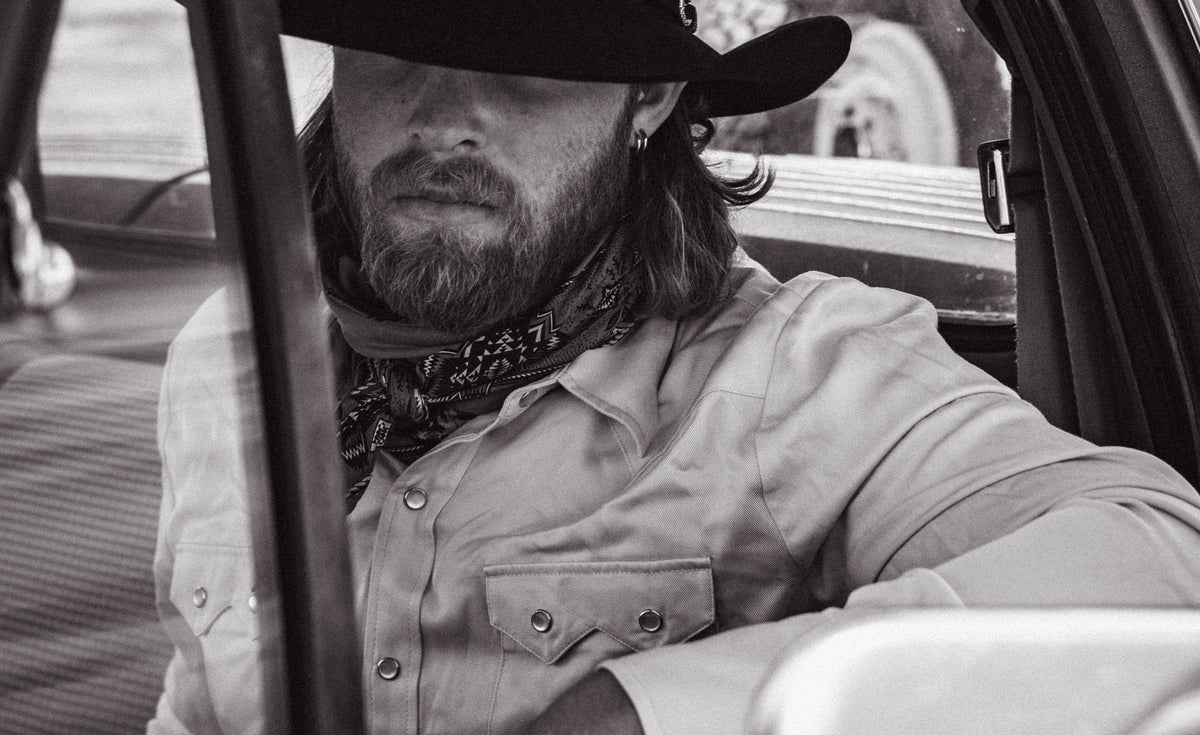
Western makers, like H Bar C, adopted it after the war, and it’s easy to see why. Snaps open fast, they don’t fall off the way sewn buttons do, and a row of them running down the front, across the pockets, and onto the cuffs gives the whole shirt a connection. It’s worth knowing that a pearl button and a pearl snap aren’t the same thing. One is sewn on through a shank. The other is a mechanical fastener with a decorative cap on top. From across a room, though, you’d never tell them apart, which is a big reason the history gets so tangled.
The yoke: tailoring that turned into a signature
Every shirt yoke starts as a practical panel across the shoulders. It shapes the fit and spreads stress across the back. Western makers just kept pushing it. They cut it deeper, gave it points, made it in a contrasting color, outlined it in piping, and repeated it on the front. By 1939, catalogs were advertising shirts with a fitted deep yoke front and back.
Our own Western story comes out of that same tailoring tradition. Samuel Christenfeld started in Brooklyn in 1897 making fitted riding clothes, and that equestrian approach to fit is still in our patterns today. Our Denver shirt dates to 1938.
The pockets: a slant that became a language
Two chest pockets made sense for anyone who spent the day on a horse, since reaching into your pants pockets in the saddle isn’t easy. The shape of the flap is where things got interesting. Levi Strauss put a simple slanted flap on its Cowboy Overall Shirt in 1926. By the late 1930s there were smile pockets, arrow flaps, pointed flaps, and embroidered pockets. What started as a way to keep your tally book from falling out turned into one of the main ways brands told their shirts apart.
The cuffs: built for rope
The deep cuff with three, four, or even five closures is one of the most recognizable parts of a Western shirt, though nobody in 1939 called it a rodeo cuff. Catalogs just listed fitted three button and four button cuffs. The reason was practical. If you’re dallying a rope around a saddle horn, loose fabric at your wrist gets in the way, so riding tailors cut the cuffs close and long. Once snaps replaced the buttons, that row of pearl caps became one of the first things your eye lands on.
The tail: older than the cowboy
The long shirttail isn’t really a Western invention. Men’s shirts were cut long and worn tucked for most of the nineteenth century. The Metropolitan Museum of Art has an 1880 shirt whose whole lower half was never meant to be seen. Western makers kept that length because a rider is bending, reaching, and twisting all day, and a short shirt won’t stay in his pants.
The trim: made to be seen from a distance
This is the part most people credit to Hollywood, and it isn’t quite right. Contrast piping, satin, and embroidery were all in commercial catalogs before World War II. Pre-war catalogs sell shirts in red, purple, gold, cerise, orange, and silver, with piping tracing the collar, yoke, and cuffs so the shape reads from fifty yards away. The embroidery was already there too: steer heads, horseshoes, saddles, boots, and bucking broncs.
What changed after the war was ambition. In 1947 H Bar C Ranchwear brought on Margaret and Frank Miele to run embroidery production, and our work with Nudie Cohn pushed embroidery and appliqué further than the industry had gone before. A young Manuel Cuevas was learning at Nudie’s side during those years. Gene Autry, Roy Rogers, John Wayne, and Elvis Presley all wore what came out of that period.
Putting it back together
Take any one of these details on its own and you’ve just got a shirt with a nice pocket or an interesting cuff. Put them together and it reads as Western before you’ve even looked at the person wearing it. None of it was invented all at once or by any one person. It was worked out over decades by riding tailors, fastener engineers, catalog houses, rodeo riders, and embroiderers, each adding something that stuck.
We, H Bar C Ranchwear, have been making these shirts through most of that history, and some of the ones we made in the 1930s are still being worn today.