
記事: 8 Things Your Jeans Know That You May Not

8 Things Your Jeans Know That You May Not
Most of what gets written about denim history is guesswork. Part of the reason is literal. When the 1906 earthquake and fire hit San Francisco, Levi Strauss & Co. lost its headquarters and most of its early records with it.
So the stories filled in. Some are true. Some are better than true. Here are eight we find interesting.
1. Indigo comes out of the vat the wrong color
Dip a rope of cotton yarn into an indigo bath and it comes out yellow green.
Then it turns blue in front of you.
Indigo doesn't dissolve in water, so the dye is chemically reduced into a soluble form first. The yarn soaks it up, rises into the air, and oxygen turns it back into blue indigo locked onto the fiber. Then it goes back down. Three to nine dips is typical, each one adding another layer of blue.
2. Only the outside of your jeans is blue
All those layers build on the surface of the yarn. The core stays close to white.
That's why jeans fade. You aren't washing the color out. You're wearing the blue skin off and exposing the white underneath.
It's also why the inside of your jeans looks lighter. In classic denim, only the lengthwise yarns are dyed. The crosswise yarns are left undyed, and they show mostly on the back of the cloth.
3. The looms are best set on wooden floors

Cone Mills' White Oak plant in Greensboro, North Carolina made some of the most famous denim in American history. Its old shuttle looms weighed about 3,500 pounds each, and they ran on the mill's original wooden floors.
As with the first law of thermodynamics, that's a lot of energy to transferred in to the ground, and immediately transferred back.
The people who worked them said the wood absorbed the shaking and over time the story grew. The floors flexed, the looms moved, and the movement gave White Oak denim its character.
Fact? Maybe? Nobody has ever run the test to be sure. No one has woven the same yarn on the same loom, once on wood and once on concrete, and measured the difference. It's the most famous theory in denim, arguably the most interesting. People claim they can see the difference to this day.
4. The famous looms came after the famous denim

Say "selvedge" to a denim collector and they'll picture the Draper X3, the American fly shuttle loom that White Oak made legendary. The X3s at White Oak date from the 1940s and later.
Levi's red line selvedge 501 was developed in 1927. It was woven on looms about 29 inches wide, more than a decade before the machines most people credit for it.
5. Selvedge disappeared because the cloth got wider
That red line was never a luxury detail. A narrow shuttle loom finishes its own edge, and Cone marked the edge of Levi's cloth so everyone knew whose it was.
Levi's red selvedge ran through 1983. Around 1984, Cone moved the standard 501 to a wider, more economical loom. The cloth came off double width and was cut straight down the middle.
No finished edge. No red line.
The detail people now pay extra for is simply what narrow cloth used to look like.
6. Cone put the looms in storage, then had to go find more
Cone phased its old shuttle looms out during the 1980s and few were saved.
In the 1990s, demand for selvedge came back, and the stored Drapers went back to work. By 2013 demand had outrun capacity, and Cone was tracking down and restoring more old X3s just to keep up.
White Oak closed at the end of 2017. Forty six of its X3s were sold to a new owner. The machines outlived the mill.

7. Saddles designed your jeans
Cowboys are tough, and sometimes tougher than their denim which is why companies started using brass re-enforcements on their denim.
However, in 1937, Levi's covered its back pocket rivets because the exposed copper scratched saddles and furniture. In 1966 the rivets came out entirely.
Lee went to cowboys directly. Its 1925 Cowboy Waist Overalls were developed after consulting working cowboys and rodeo riders, and Lee replaced exposed copper on the back pockets with stitching so the jeans wouldn't tear up a saddle.
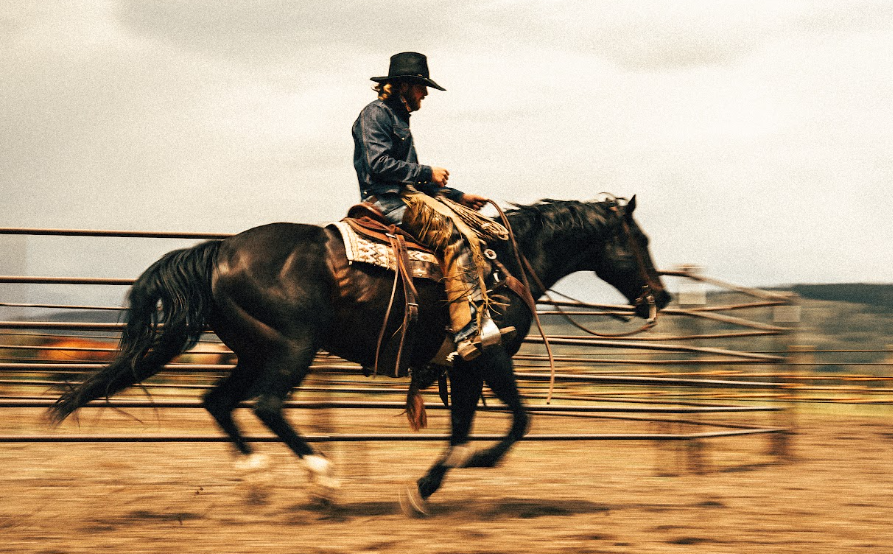
Wrangler went furthest. Its early cowboy jean was patterned around sitting on a horse. Back pockets and watch pocket set high enough to reach while mounted. Seven belt loops. Flat rivets that wouldn't scratch tack. Seams felled inside and out, so nothing rubbed or split on a long day in the saddle. All designed by famous Rodeo Ben.
8. Lee first put zippers in cowboy pants in 1927
Button flies were the rule. Lee broke it.
In 1927, Lee put what was then called the hookless fastener into its cowboy pants. It would be decades before a zip fly was normal on a pair of jeans. They actually had a competition to name this new feature, a name that did not carry forward to say the least... okay fine we will, "the Whizit"...lol
What the jeans remember
Facts from mill workers, dye chemistry, patent dates, and the practical problem of a man sitting on a horse all day.
The best details in denim were never designed to look authentic. They were designed to work. Next time your buying denim, look for the details.
Details worth keeping.
