

The Bucking Horse: An American Icon Worth Arguing Over

At H Bar C, we believe that true Western style is never accidental. It is earned. It is lived. And it carries a story.
Few symbols in the American West carry more weight than the bucking horse and rider. Instantly recognizable, fiercely independent, and rooted in grit, the silhouette has come to represent the spirit of Wyoming and, more broadly, the enduring identity of the cowboy. But like all powerful symbols, its origin is layered, debated, and rich with character.
Here is the story (or at least as much as we know)!
A Symbol Born of State Pride
The version most widely accepted begins in 1935 (we go back to1918 in a bit, keep reading).
Lester C. Hunt, then serving as Wyoming’s Secretary of State and later its Governor and U.S. Senator, wanted a symbol that captured Wyoming’s identity. The cattle industry was central to the state. Rodeos were staged across its towns. The cowboy was not mythology. He was daily life.
Hunt commissioned Allen True, an artist from Littleton, Colorado, to design a bronc for Wyoming license plates. True was paid seventy five dollars for his sketch. In today’s dollars, that is roughly one thousand. A modest sum for what would become one of the most enduring emblems in the American West.
The bucking horse and rider first appeared on Wyoming license plates in 1936. That same year marked the fiftieth anniversary of the University of Wyoming. The design was not merely decorative. It was practical. Counterfeit license plates had become an issue, and the intricate bucking bronc made duplication far more difficult. The first year the plates debuted, revenue more than doubled.
The symbol had arrived.

But the Story Does Not End There
As with many Western legends, there are competing claims.

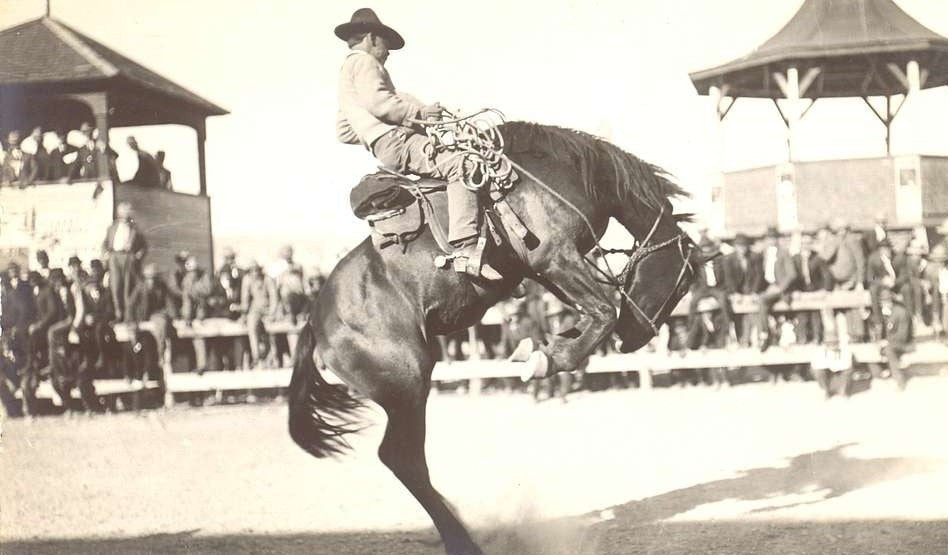
One widely cited influence is the photograph of Guy Holt riding the horse Steamboat at the Albany County Fair in 1903. That image became deeply associated with Wyoming’s rodeo culture. Some accounts suggest that in 1932 the photo was presented to Hunt and that he promised to use it if elected governor.
Others trace the symbol back even further.
The Wyoming National Guard reportedly used a bucking horse and rider as early as 1918 during World War I. Soldiers painted it on equipment, road signs, and even helmets. When German forces encountered the image, some accounts say they created jewelry featuring the bronc. The mark had presence long before it ever appeared on a license plate.
There were even local claims. Leslie E. Wright said he created the symbol while designing a sign for his Dubois tavern. George Ostrom claimed he originated the design while serving in the National Guard during World War I.
Like all good Western stories, the truth rides somewhere between documented fact and oral tradition.
Steamboat and the Spirit of the West
At the heart of many of these stories stands Steamboat, the legendary bucking horse. Known for his power and unpredictability, Steamboat was not easily ridden. He became a symbol of challenge, resilience, and Western toughness.
That is the point.
The bucking horse is not calm. It is not decorative. It is defiant. It captures motion, resistance, and independence in a single silhouette.
That spirit is what endured.
Why It Still Matters

Today, the bucking horse is inseparable from Wyoming’s identity. It remains on license plates. It appears on road signs, helmets, athletic uniforms, and countless expressions of state pride. It is not owned by trend cycles. It is rooted in heritage.
For us at H Bar C, that matters.
Western style is often borrowed, imitated, and reinterpreted. But the bucking horse reminds us that true Western identity is not costume. It is history. It is labor. It is rodeo dust and National Guard grit. It is state pride forged in cattle country and carried through world wars.
When we design, we think about symbols like this. Not to copy them. Not to capitalize on them. But to respect what they represent.
The West is not aesthetic first. It is identity first.
A Silhouette That Refuses to Be Tamed
The bucking horse has been debated, claimed, and re claimed. Artists, soldiers, tavern owners, and politicians have all been tied to its origin story. Yet the power of the symbol does not depend on a single name.
It depends on what it represents.
Independence. Motion. Strength. A refusal to be broken.
That is the West. And that is the spirit we honor every time we cut a pearl snap, stitch embroidery, or design a shirt meant to last.
Some symbols fade.
The bucking horse never has.