
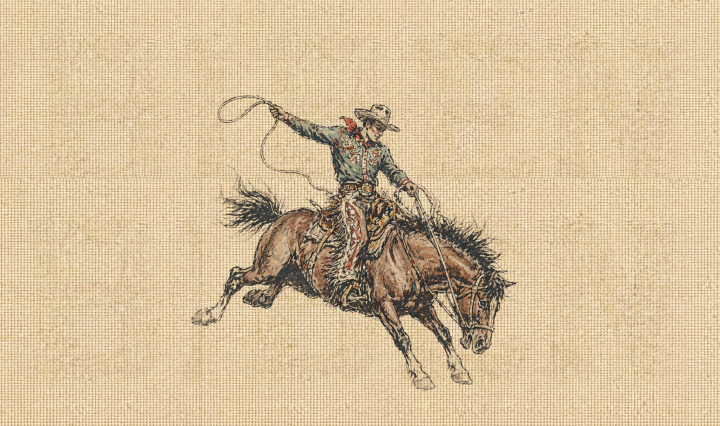
The Immigrants Who Invented the American West
The western shirt did not begin in America.
It began with Spanish cattlemen called vaqueros working land in Mexico before the United States existed. It was shaped by the embroidered costumes of bullfighters in Spain, refined by Native American leather workers and Mexican ranch hands, and eventually handed off to a generation of immigrant tailors in the American Northeast who turned it into something the world had never seen before.
Before There Were Cowboys
When Spanish colonizers arrived in the Americas in the 16th century, they brought cattle, ranching, and the traditions built around both. The vaqueros who worked those herds wore light cotton shirts, sometimes pleated and embroidered, cut long in the body to stay tucked while riding. A shoulder yoke ran across the back, derived from the wooden yokes worn by oxen, for durability and sun protection. These were working garments, built for a specific physical life.
The word vaquero, pronounced B'akero, is where buckaroo comes from.
When the United States annexed Texas in 1845 and absorbed vast swaths of formerly Mexican territory through the Treaty of Guadalupe Hidalgo in 1848, the vaqueros did not disappear. They trained the new settlers. American cowboys adopted their horsemanship, their rope skills, and their clothing, then made all of it their own.

The Show That Changed Everything
By the 1880s, Buffalo Bill's Wild West shows were touring the country and eventually the world. They took the romanticized image of the cowboy, brightly colored shirts, embroidered yokes, bolero jackets borrowed from the bullfighter's traje de luces, the suit of lights, and burned it into the public imagination.
Rodeo performers started dressing for the audience. Silk and satin shirts with multicolored yoke panels. Floral embroidery across the collar, chest, and back. Elongated cuffs. The practical working shirt of the vaquero had become a costume, and eventually, a fashion statement.


The Tailors Who Built the Look
By the 1930s, a generation of immigrant tailors had set up shops to meet demand. Three of them would define the visual language of Western wear entirely.
Bernard Lichtenstein, Nathan Turk, and Nudie Cohn were each born to Jewish families in Eastern Europe and immigrated to the United States in the early 1900s. Their design vocabulary was drawn from the richly embroidered national dress of their homelands, the pictorial motifs of Poland, Ukraine, Hungary. When they applied those craft traditions to Western shirts, something entirely new appeared. It looked American. It was built from everywhere.
Bernard Lichtenstein: The First
The Country Music Hall of Fame identifies Bernard Lichtenstein as the first celebrity Western wear designer. That title belongs to him alone.
He was born in Poland in 1893, the son of a tailor, into a family whose craft ran back generations. He immigrated to America at fourteen with his parents and siblings and the family settled in Philadelphia. By the 1920s he was working as a woolen goods salesman when orders started arriving for fabric in colors nobody stocked, hot pink, purple, shades that had no business being in a catalog. They were coming from rodeo performers. A trick shot artist named Mamie Francis was among the first.
Lichtenstein had the tailoring background. So he started making the garments himself.

In 1930 he opened his storefront at 3209 W. Columbia Ave. in Philadelphia under the name Ben the Rodeo Tailor. He later moved his flagship to 6240 N. Broad Street. Business came through word of mouth and mail-order catalogs that touted his work as the expression of perfection. His clients grew to include Gene Autry and Roy Rogers, Hollywood's two biggest singing cowboys, along with country music performers across the country.
Someone once pointed out that it seemed odd for a Western wear designer to be working out of Philadelphia.
Rodeo Ben's answer: As long as I make the right stuff in the east, they'll buy it in the west.
In 1947, Wrangler commissioned Lichtenstein to design what would become the 13MWZ Cowboy Cut jean. That garment is still in production today. For years, Wrangler clothing carried a tag that read: Designed by Rodeo Ben, custom cowboy tailor.
He ran his shop until retirement. His son Gerson took over, also known as Rodeo Ben. Bernard Lichtenstein died in Philadelphia in 1985 at the age of ninety.
Nudie Cohn and the Line That Became HBarC
If Rodeo Ben was the first, Nudie Cohn was the loudest.
Born Nuta Kotlyarenko in Kiev, Ukraine in 1902, he immigrated to New York as a teenager and eventually made his way to Hollywood, where he opened Nudie's Rodeo Tailors in 1947. His work was operatic. Rhinestones, embroidered cacti and wagon wheels, suits that caught stage light from fifty feet away. He dressed Hank Williams, Porter Wagoner, and Elvis Presley, whose gold lamé suit became one of the most recognized garments in American music history. The Nudie suit was not just clothing. It was a declaration.
It was during these years that H Bar C came looking for him.
Our company had started in 1897 in Brooklyn, under the name Tailoring by Christenfeld. Samuel Christenfeld, a young tailor with an eye for quality and an English riding flair. A partnership with Mel Halpern in 1906 produced Halpern and Christenfeld. When Christenfeld bought out his partner, the name shortened to H-C, then changed again. By the time the brand was known as H Bar C, it had already been dressing people with exacting standards for decades.
After Samuel's death in 1939, the brand moved west. His son Seymour opened the Los Angeles office and established H Bar C's Hollywood operation. The timing was not accidental. Western films were at their peak. The stars who wore Western clothing on screen were the most recognizable people in the world.
H Bar C recruited Nudie Cohn, not to follow the market, but to lead it.
Nudie brought his full vocabulary to the work. The embroidery, the rhinestone detail, the sense that a Western shirt should stop people cold. H Bar C produced some of Nudie's own lines alongside our own, and the collaboration pushed both forward. Working alongside Nudie during those years was a young designer named Manuel Cuevas, who would go on to become one of the most revered names in Western tailoring. That lineage runs directly through H Bar C.
The brand that Samuel Christenfeld built in a Brooklyn workshop in 1897 had, within a generation, become the house that dressed Hollywood's West.

The Thread That Runs Through
Rodeo Ben. Nudie Cohn. H Bar C.
Three different operations, three different cities, built on the same foundational belief. That Western clothing deserved the same craft and intention as anything made for a stage or a red carpet. That the person wearing it, whether a rodeo rider in Philadelphia or a movie star in Los Angeles, deserved something that would last.
The western shirt has cycled in and out of fashion more times than anyone can count. What survives each cycle is not the trend. It is the craftsmanship underneath it.
That has always been the standard. It still is.